Showing posts with label nostalgia. Show all posts

19 January 2018

Detectorists


Detectorists is a lovely example of British television at its best; poignantly humorous yet sensitive, emotionally deep and intensely rewarding.
 
Andy and Lance live in a rural English backwater that superficially seems quiet and uneventful. Writer (and portrayer of Andy) Mackenzie Crook's genius is to show us the rich comic beauty that lies beneath. They are searching for an elusive horde of Saxon gold and the ups and downs they face cleverly mirror the vicissitudes of their journey through life.
 
The pair are intelligent, well-read, avid viewers of highbrow quiz shows but, by the capitalist standards of modern life, serial under-achievers. However, the humour never belittles them. Instead their male slant on life is lent a dry, sometimes morose, and often wistful comic voice. Andy and Lance are highly endearing, their eccentricities laced with humility. Perhaps we see ourselves in them and consider them as easy for us to befriend.
 
The actors are gentle, credible and very English; the rural Suffolk air thick with seeds and insects and pollen. It’s a beautiful setting, far from the ugliness of modernity. What starts as a simple premise, two middle-aged men trudging across fields, gently swinging their detectors while musing on the curiosities of life, develops plots, sub plots and village goings-on that draw you in.
 
We are shown only subtle clues. Nothing is thrust at us. Potentially vital hints at the direction of things to come are hidden away, shown on screen for a split second. Those who get up early to make a cup of tea when they see the closing credits and the viewpoint panning out and up will miss much. Understatement is used powerfully and sits in perfect keeping with the overall mood.
 
The music plays a vital part. The theme tune in the style of old English folk and the incidental variations sit perfectly with ploughed fields, rich earth and Mother Nature. Which other dramas show us close ups of summer meadow flowers, insects and birds?

Two of the three short seasons are on Netflix. Detectorists comes highly recommended as a deceptively powerful piece of television which by rights should win numerous awards. I can't wait to see what Mackenzie Crook dreams up next!
 
PS: Remember, the tools are metal detectors, Andy and Lance are detectorists!
 

10 January 2017

The Retiring Assistant Manager – 30 March 1990

The retiring assistant manager scribbled his last initial and put down his weary ballpoint with an air of finality. His “in tray” was empty, his “out tray” full and yet there were loose ends; things remained undone and must now forever remain so. The sand lay flat in the lower chamber of life’s hourglass. Intentions, objectives, ambitions; these were the loose ends which could not be neatly knotted.

He drew comfort from the tangible and pondered the forest of paper that had traversed his desk these four decades, hungrily sucking the ink of a thousand pens; gorging the graphite of a towering pencil. His mark lay on reams of records stowed safely in the banking bowels below; tasks completed, returns returned, ledgers ruled and checked. There lay the rich seams of evidence indelibly stamped in banking history.

He had safely shouldered a mountain of responsibilities with his unique monogram. A million signatures had authorised, confirmed, advised, certified, applied, declared, reported and claimed. Now our man reached for a cigarette and wreathed himself in its haze. His mood of reflection continued and he seemed almost to disappear within the rafts of blue and grey, his mind adrift on a sea of nostalgia. An endless tide of faces, names, places, conversations ebbed and flowed, removed from time and context. When reality returned he would try to remember these details in ordered fashion, but not yet. Enough for now to indulge at random.

A column of white ash dropped unnoticed. Imagination slipped its leash and began to pad softly down the corridors of wistful thought where there were unopened rooms containing untested talents, unexpressed emotions, abandoned projects, forgotten thoughts and lapsed aspirations. There was so much to do, yet so little time. With frightening suddenness, conscious thought returned to him. His empty desk stared gravely back at him, an old and trusted friend. He must remember to bid his faithful wooden companion farewell. But how to say, “Goodbye?” How to say, “I won’t be back?” Soon its drawers would fill with unfamiliar clutter and this it would accept with brave resignation or bland indifference, he did not like to contemplate which. 

Sadness came over him; ‘end of an era’, a woefully inadequate phrase. He glanced at the relentless clock, willing it to stop and encapsulate the moment. On it marched, into the future. Why couldn't it just mark time or pass the time of day? He laughed aloud at the irony and with that the spell was broken and the fleeting moment of regret passed. The future held the key to those unopened rooms of opportunity, potential, and above all, time. With spirits rising he left the Bank.

A broad grin spread across his face as he detected a spring in his step, which had not been there yesterday. Was that last step more of a skip? The years rolled back and he summoned a memory from one glorious July afternoon half a century earlier: a small boy riding home from school, standing on the pedals, eyes ablaze with anticipation at the summer holiday stretching endlessly ahead.

He hadn’t felt like this in years. Cares, worries and responsibilities lay strewn in his wake as he hurried towards his tired, old car. His mind whirled with anticipation on the drive home. He concentrated on nothing in particular, allowing himself to bask in expectation: summer, cricket, gardening, Vivaldi, travel, sun, solitude, deck-chairs, reading, ...  he was drowning in euphoria. Full of unabashed excitement he hurried home to the future and with a sigh of relief closed the door on a most eventful day.

The beginning…

22 October 2015

Marc Bolan & T. Rex


He was a passenger in a purple Mini 1275GT (registration FOX 661L) driven by Gloria Jones as they headed home from Mortons drinking club and restaurant in Berkeley Square. Jones lost control of the car: it struck a steel reinforced chain link fence post and came to rest against a sycamore tree after failing to negotiate a small humpback bridge near Gipsy Lane on Queens Ride, Barnes, South West London. Neither occupant was wearing a seat belt. Wikipedia.
 
It's fashionable to talk of the 27 club, a roll call of rock heroes whose lives were cut tragically and coincidentally short at that age. The list includes some big names and there are many more whose lived on the edge and managed only a year or two more. Marc Bolan's star shone brilliantly but briefly until 1977 when he was the passenger in that car, aged 29.
 
'Metal Guru' by T.Rex was the first single I bought. That was in 1972, already past his heyday. The song went to number one in the charts and kept Elton John's famous 'Rocket Man' off the top spot. It's typical of Marc Bolan's output after he abandoned his acoustic guitar, his rug and joss sticks in favour of a Gibson Les Paul and Marshall stack. Many say those muscular riffs and simple, repetitive lyrics, combined with feather boas, high-waisted flares and a huge head of black curls did as much to usher in the dawn of Glam Rock as Bowie's Ziggy.
 
Frankly, listening to his material these days, I find the two significant T Rex albums are full of the same song rewritten over and over again. That was his ultimate downfall. He openly claimed that his artistic endeavours had little to do with art. His sole aim was to achieve fame and adulation. That he did on a scale only previously seen with the Beatles. But a one-trick pony get's stale and teen girls grow up.

Marc Bolan's star waned while his drink and drugs consumption (and apparently an addiction to fast food) rose.
 
By 1977 his hour was long past; his fans had drifted away and he resembled a bloated caricature of his former waif-like self. However he had lost none of his self-belief, had assembled a new band and was in the process of hitching his cart to the new punk train. He had lost fifty pounds, and by all accounts was fitter and healthier than ever when fate intervened.
 
Looking back, I think he took as much from the music scene as he bequeathed to it. His legacy is good but not magnificent; his mark a bright flash rather than an all-illuminating dawn. With the benefit of forty years' hindsight the posturing, image and attitude look contrived but, it takes you back doesn't it!

02 May 2014

snooker, the art and the act


As I watch the snooker World Championship, half a day behind, on the BBC iPlayer, my mind drifts back to the dozens of long evenings I spent with my brother at Claude Falkiner's Snooker Club in Bournemouth in the late 1970s. The annual World Championship event had just moved to the Crucible Theatre in Sheffield, an aptly-named, claustrophobically small venue (still to this day the spiritual home of this high-precision sport) and was enthralling television audiences the length and breadth of England, and beyond.

My brother and I, inspired by the hushed TV spectacle, quickly learned the rules, bought (nearly straight) cues and took out membership at a dingy, smoke-filled hall, housing twelve full size tables. The beauty of close-up TV cameras is that we had pretty much mastered the stance, the grip, the bridge, the cue action, and the all-important mannerisms before even leaving our armchairs.
 
In fact, before I struck the cue ball you could be forgiven for assessing in me a good degree of experience. Striding around the table with an air of confidence, I would eye up potential chances and occasionally pause to take a pace or two back, as if I had almost overlooked a distinct opportunity. I picked invisible fluff from the table, checked the scoreboard and ground chalk onto the tip of my cue before settling into a convincing stance and addressing the cue ball.
 
This was the point at which the illusion was shattered. Frequent mis-cues saw the white speared off the table to go skittering across the floor under table after table. I won't dwell on the embarrassment of retrieving the cue ball from a distant corner of the hall.
 
It's clear from my modern perspective that as much as we wanted to achieve some modicum of expertise at snooker, my brother and I, we wanted to emulate the consummate professionals we saw on screen, to play the game with integrity, sportsmanship and above all style. Despite missing four out of every five pots we attempted, we would shake our heads every time in mock confusion, as if surely some external force had caused the miss. Often we would turn with a pained expression to address an invisible but clearly sympathetic crowd, just like the pros did.
 
Our standard improved with practice and we began to learn the potting angles on those gigantic twelve foot tables with the slim pockets, lightning fast cloths and super-responsive cushions. We added top-spin or a 'dab of side', and attempted deep screw shots. Nonetheless we could seldom pot more than two reds and two colours before finishing tucked up on a side rail, hopelessly out of position. But, following the example of our idols, we let our frustration show with only a barely perceptible wince, a purse of the lips; more perplexion than irritation.
 
The exuberant rehearsals of our late teens and early twenties gave way to manhood, and responsibilities; grown-up commitments reduced our snooker sessions to occasional outings. Nonetheless the sport has held my fascination over three decades.
 
 
The mannerisms and the etiquette are still entrenched in the modern game and it's one of the very few sports where players will call their own fouls; so small are the margins for error that referees can't always detect them. Dress code and demeanour are as exemplary as ever. The psychological pressure and the mental stamina required for thirty-five frame, two-day matches, relentless. The whiskey glasses and overflowing ashtrays are long gone; replaced by iced Perrier.
 
The standard of play continues to soar. In the 1970s we saw the very first televised maximum break, 147 points: fifteen reds, fifteen blacks and the six colours in sequence. Now there are several players who have achieved this several times over. In the 1970s few professional players had scored more than fifty breaks in excess of one hundred points in their entire careers. In 2014 the world number one has just achieved one hundred centuries, in the current season alone.

22 January 2013

the final days of steam

Lately I have been riding a wave of nostalgia. This should come as no surprise, bearing in mind my preference for looking to the past rather than the future. I believe I am in a minority there but a sizeable minority. After all, how glorious it is to bask in the warm glow of happy memories and uncomplicated times. Our brains cleverly filter the not so good and the plain awful leaving a sense that life used to be better.
 
In particular I have been wallowing in The Rank Organisation’s “Look at Life” series of documentary ‘shorts’ from the nineteen fifties and sixties. That bastion of the British film industry Rank, which blossomed from unlikely roots in flour milling, produced and distributed its own films and screened them in its own cinemas to fill slots between features. There is a store of some five hundred of these miniature ten-minute classics covering technology, culture, sport, transport and innovation, a showcase for all that was great about Great Britain.
 
Sixty years ago the Second World War was a very recent memory, there was unemployment, often poor sanitation, no central heating, and life was devoid of the luxuries we take for granted today. So, yes, life was harsh. But what shines through in these films is an indomitable spirit and an optimism which seems to have vanished from Britain today.
 
The narrator’s excitement when describing the launch of a new hovercraft on the Solent, or the introduction of Motorail, a miraculous new system for transporting cars on trains, is infectious. Progress happened because of decisive action. Plans were laid quickly but mostly carefully. This was all long before the arrival of decision by committee, when even the simplest idea becomes bogged down in endless enquiries and feasibility studies. It was an age of confidence and hopefulness. However it would not last.
 
Chill winds began to stir with publication of the first Beeching Report in 1963. Doctor Beeching took an axe to the British Railway system, hacking off four thousand miles of line and earmarking for closure, one third of the country’s seven thousand stations. This came at a time when the railways were already struggling to consolidate in a new era of diesel and electrification.
 
That brings me neatly though not consequently to the demise of the steam locomotive, still in the 1950s a technological wonder. In the glory days of steam entire families found jobs for life and shiny-faced schoolboys scampered along platforms clutching notebooks and pencils to record their sightings. Trains clanked into stations puffing and hissing like massive lungs while others streaked through non-stop whistle screaming and smoke flattened to its back. There is something elemental about steam power, the production of staggering forces of locomotion from the simple fusion of fire and water.
 
But all too quickly steam trains had become dinosaurs with their reliance on coal. Soot blackened hulks were shunted to the scrapyard like huge, gentle beasts to the slaughter. Steam trains continued to run on the Southern Railway, my own neck of the woods, until June 1967 when the final steam locomotive puffed out of Waterloo on its way to Weymouth. I am delighted that far-sighted souls have preserved the very best examples for posterity allowing ninety tons of steel and iron to thunder across countryside at one hundred miles per hour, steam and smoke billowing in its wake.
 
Now, back to my Look at Life!

28 July 2010

young me, now me


1960


2010

I was squeamish about wearing white socks and sandals but in the interests of recreating a photo of me from fifty years ago I reluctantly pulled them on. Please note, the ridiculous facial expression is deliberate!

21 June 2005

A man of many parts, most of them faulty


Part One: Today I know there is no point to anything. Nothing I have ever done was worthwhile. I am incapable of accomplishing the simplest task to my satisfaction. Future days bring hell. I can never make myself understood. My worth is approaching zero. A glance in the mirror reveals the face of an idiot. I am my own harshest critic. A forty seven year old man speaking like an eight year old child...

Fifteen years ago I admitted defeat. My doctor prescribed Temazepam and Lofepramine. I systematically reject most offers of help and so of course I rejected these. The addictive properties of anti-depressants did not make sense to me. Detect the faint whiff of burning martyr? Yep, right on. I asked for help and when it was offered I turned my back. All I accepted was a sick note for work. I declined to talk to any form of counsel...

I am independent to the point of stupidity. I would perform my own dentistry if I knew where to buy novocaine. I don’t need help. I told the world to fuck off and I shuffled backwards into a shell of denial and misery. I lost friends. Who needs friends when you have misery to enjoy?

Part Two: I’m a lucky guy. The sun is burning my neck from high in the sweetest, bluest sky ever. I have two supportive sons and my wife, enough money and independence to indulge my passions to excess and a lovely house. I have the electronic gadgets I need and some I don’t. I am blessed with a loyal best friend.

I am free of addiction and I have reached middle age without losing any limbs. I have all my own teeth and a few remaining hairs. I have friends in the blog world. My corporate employer has yet again reached the point in the business cycle where they might consider paying off a load of old-timers. Just gimme that cheque...

Part Three: Which one is the real me? You know the answer, both are me yet both are faulty. Monday I am so pissed-off I can barely mutter a greeting to anyone. I want to hurl out all my prized possessions. Tuesday I listen to the best music ever driving with the windows down, write beautiful words and smell the sweet mown grass in my garden.

I am good at swooping from euphoria to misery, often within hours. I like the way I am. I don’t pretend to be anything I am not. Work colleagues think I’m unfathomable, I talk in riddles and appear aloof. Stuff ‘em, I know which people I value, they are right here.

And just when you think you know someone they unload all this... No, now I think about it you guys all read between the lines anyway.

"I’ve got a little black book with my poems in."Pink Floyd – Nobody Home

12 May 2005

Nostalgia


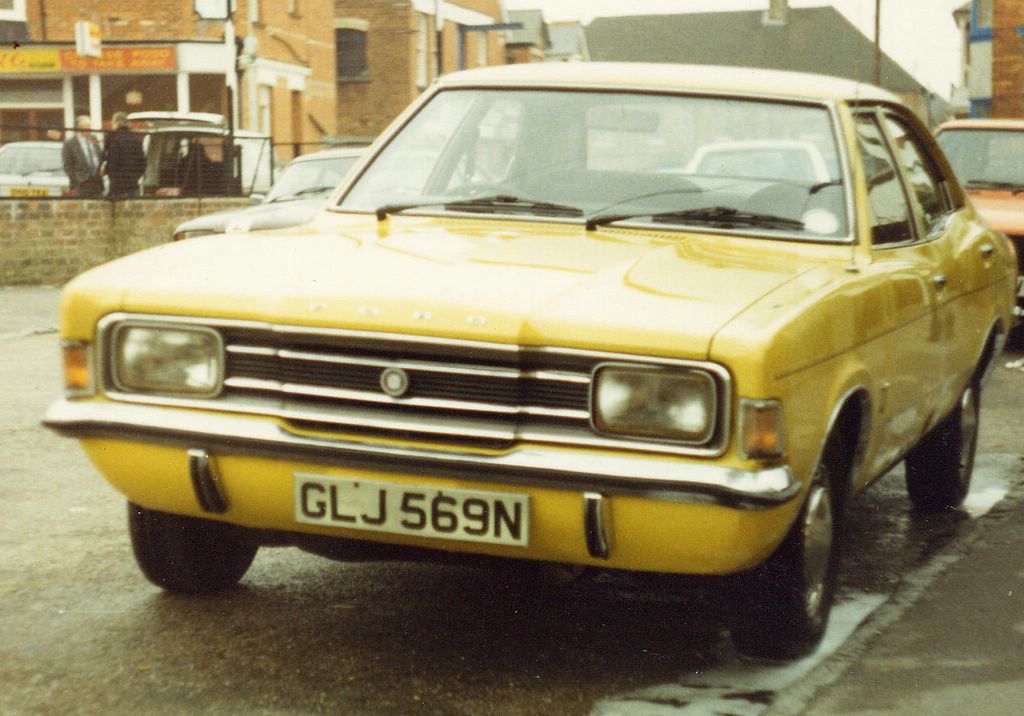
Ford Cortina 1.6GLX, a 1970s icon in Daytona Yellow.

When I drove this car, personal computers and mobile phones were confined to the pages of science fiction. Hi-fi meant indiscernible lyrics behind pops and crackles. Mars bars were eight inches long and town centres were deserted after 10pm.

Parents regarded swing parks as safe havens for their children. The worst that could befall them was having their sweets pinched by the local bully. Daisies grew all summer under skies of the deepest blue. We lay on our backs feeling the warm grass, talking about rock n' roll. Sally kept looking away whenever our young eyes met then fell about giggling with her friends.

Good strong men were in charge of the country. War hardly ever happened and TV was wall to wall gentle game-shows and cartoons. Boys settled their playground differences with fists, not knives. We skipped without embarrassment.

Evenings were long and happy. It never rained from May to September. Footballers shook hands. I heard from my pen-pal just three times a year. Postmen delivered mail the very next day, before breakfast. Eggs were huge with feathers stuck to the shell and carried soft orange yolks.

Tomatoes were crimson and marmalade tasted of oranges. Tinned pear halves came in juice or syrup. Custard was dark yellow and cream was good for you. Very few E-additives had been added. Apples were sweeter and crisper.

Cows only came in black and white, horses were always brown. Dogs never bit only barked. Bumble bees bumbled. Banks were honest, Post Offices only sold stamps and nobody spoke in the library.

Nothing in a child’s toy box needed batteries or a plug. We had no need for display screens, menus, drivers or operating systems. Depression was unknown, people suffered a breakdown in the privacy of their own home.

Telephone numbers were four or five digits. Only famous people were ex-directory. Coins were heavy and banknotes were long and wide. A chequebook made you feel important.

Who said "Nostalgia ain't what it used to be!" – I did!